
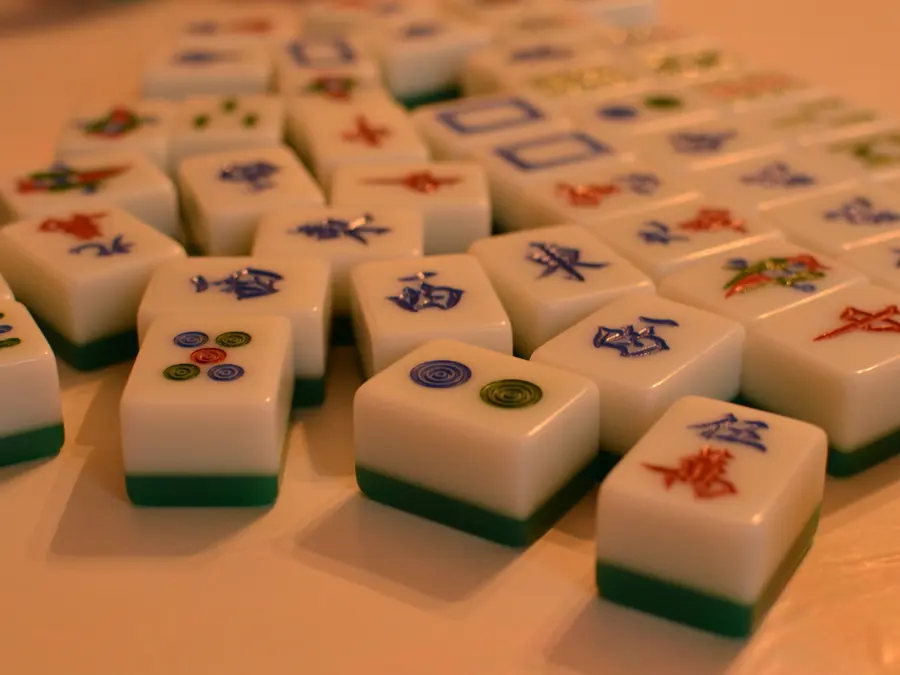
The tiles
A full set has 144 tiles. There are three suits (bamboo, characters and dots) numbered 1 to 9, four of each tile. There are also four winds and three dragons, four of each. The last 8 tiles are four flowers and four seasons. They are bonus tiles and are not used in sets.
Choose seats
Each player rolls two dice. The highest roller becomes temporary East. That player shuffles one tile of each wind face down, and each player draws one. The wind you draw is your seat. Seats run East, South, West, North counterclockwise around the table, so they do not match a compass.
Build the wall
Shuffle all tiles face down. Each player builds a row 18 tiles long and 2 tiles high in front of them. Push the four rows together to form a square, called the wall.
Break the wall
East rolls three dice and counts players counterclockwise, starting at East as one. The chosen player counts that many tiles from the right end of their row and breaks the wall there. The seven stacks to the right of the break are the dead wall. You draw replacement tiles for kongs and flowers from it.
Deal 13 tiles, 14 to the dealer
Starting left of the break, East takes four tiles, then South, West and North each take four. Repeat until everyone has 12. East then takes two more tiles and the others take one each. The dealer starts with 14 tiles and everyone else with 13.
Replace flowers and seasons
If you are dealt a flower or season, place it face up beside your hand and draw a replacement from the dead wall. East replaces first, then South, West and North. If the replacement is another bonus tile, replace that one too.
Turns
The dealer starts by discarding one tile. Play then moves counterclockwise: on your turn you draw a tile from the wall and discard one, face up in the center. Your goal is four sets and a pair, 14 tiles in all. A set is a chow (three in a row in one suit), a pung (three of a kind) or a kong (four of a kind).
Calling a discard
You can take another player's discard to finish a set, but you must then show that set face up. You can call chow only on a tile from the player on your left. You can call pung or kong on a discard from anyone. If more than one player wants the tile, a win beats pung or kong, and pung or kong beats chow.
Kongs
After you make a kong, draw a replacement tile from the dead wall, then discard. A kong you build from your own tiles stays concealed. You can also add a fourth tile you drew yourself to a pung you already showed.
Flowers during play
When you draw a flower or season during play, show it right away and draw a replacement from the dead wall.
Dealer and rounds
If the dealer wins, or nobody wins, the same player deals again. Otherwise the deal passes to the player on the dealer's right. A full game has four rounds (East, South, West, North), so at least 16 hands.
Sources & last checked
- en.wikipedia.org · Checked 2026-11-23
- en.wikipedia.org · Checked 2026-11-23
- www.mahjongtime.com · Checked 2026-11-23
- www.mahjongtime.com · Checked 2026-11-23
- www.mahjongtime.com · Checked 2026-11-23
- www.mahjongtime.com · Checked 2026-11-23
- www.mahjongtime.com · Checked 2026-11-23
- www.mahjongtime.com · Checked 2026-11-23
- www.mahjongtime.com · Checked 2026-11-23