
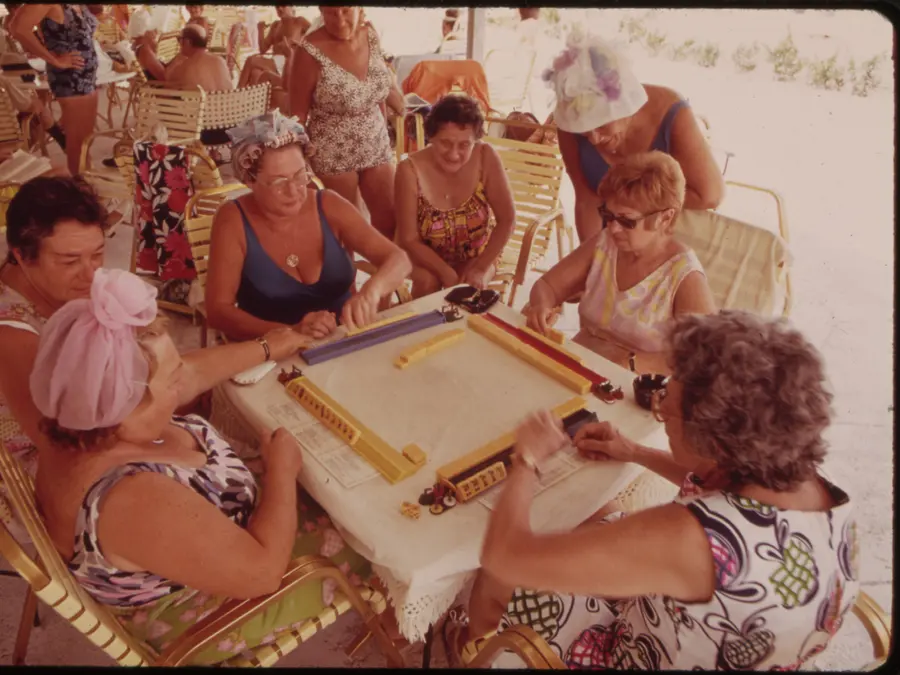
What you need
You need a 152-tile American set, one rack per player, two dice, and a copy of the current year's card from the National Mah Jongg League (NMJL). The card lists the hands you are allowed to win with. Each player should have their own card. Many players also use pushers, which are arms that clip to the rack and help you slide your wall forward.
The tiles in an American set
An American set has 152 tiles. That is the usual three suits (dots, bams and craks), the winds, and the dragons, plus 8 flower tiles and 8 jokers. A joker is a wild tile. Most other styles do not use jokers.
Racks
Each player keeps their tiles on a rack, standing up so only they can see them. When you call a discard and show a group of tiles, you place that group face up on top of your rack.
Choosing East
Each player rolls the dice. The highest roll becomes East, the dealer. The other seats follow counterclockwise: South, West, North. After each hand, the deal moves one seat counterclockwise.
Building the wall
Shuffle all the tiles face down. Each player builds a wall in front of their rack that is 19 stacks long and 2 tiles high, which is 38 tiles each. The four walls together hold all 152 tiles.
Breaking the wall
East rolls the dice and counts that many stacks along their own wall, from right to left. East splits the wall at that point. The tiles are dealt from the break.
Taking the tiles
Starting with East and moving counterclockwise, each player takes four tiles at a time (two stacks) until everyone has 12. Then East takes two more tiles and each other player takes one. East ends with 14 tiles and everyone else has 13.
Before the Charleston
Set your tiles on your rack and look for hands on the card that fit them. Because East already has 14 tiles, East will make the first discard once the passing is over.
The Charleston
Before play starts, players trade unwanted tiles in a set of passes called the Charleston. In the first Charleston you pass three tiles to your right, then three across, then three to your left. Everyone must do the first Charleston.
The second Charleston and the courtesy pass
If all four players agree, you do a second Charleston in the reverse order: left, across, right. Any player can stop it. After that, you and the player across from you may trade up to three tiles in the courtesy pass. You both agree on the number. You may never pass a joker in any of these passes.
Blind passes
On the last pass of each Charleston (first left, and last right), you may do a blind pass. You take some or all of the tiles passed to you and send them on without looking at them. You add tiles from your hand so the pass is still three tiles.
Drawing and discarding
East starts by discarding one tile. Play then moves to the right. On your turn you take the next tile from the wall, then discard one tile. Say the name of the tile out loud as you place it face up in the middle of the table.
Calling a discard for an exposure
You can call the most recent discard if it completes a group of identical tiles in your hand, such as a pung (three of a kind) or kong (four of a kind). You then place the whole group face up on your rack. This is called an exposure. You cannot call a discard to finish a pair or a single tile unless it gives you Mah Jongg.
Jokers
A joker can stand in for any tile in a group of three or more identical tiles: a pung, kong, quint (five) or sextet (six). You cannot use a joker in a pair or as a single tile. Once someone discards a joker, no one can call it.
Joker exchange
If another player has an exposure with a joker in it, and you hold the real tile that joker stands for, you can trade your tile for the joker. You can only do this on your turn, after you draw from the wall or call a discard. You can swap more than one joker in a turn.
Calling Mah Jongg
You win when your 14 tiles match one hand on the current card exactly. The last tile can come from the wall or from a discard. Say "Mah Jongg" and show your hand to the table.
Dead hands
A hand is dead when it can no longer win under the rules. Common causes are an incorrect exposure, the wrong number of tiles, or calling Mah Jongg in error and showing the hand. A player with a dead hand stops playing but still pays the winner. Jokers in a dead hand's exposures can still be exchanged.
Sources & last checked
- en.wikipedia.org · Checked 2026-11-23
- www.nationalmahjonggleague.org · Checked 2026-11-23
- www.nationalmahjonggleague.org · Checked 2026-11-23
- www.ymimports.com · Checked 2026-11-23
- www.nationalmahjonggleague.org · Checked 2026-11-23
- www.sloperama.com · Checked 2026-11-23
- www.nationalmahjonggleague.org · Checked 2026-11-23
- sloperama.com · Checked 2026-11-23