
Blind pass
A blind pass lets you send on tiles you just received without looking at them. It is allowed only on the last pass of each Charleston in American mahjong.
Look up mahjong terms, including Charleston, chow, pung, and pair, with definitions and differences between styles of play.
Last updated November 22, 2026
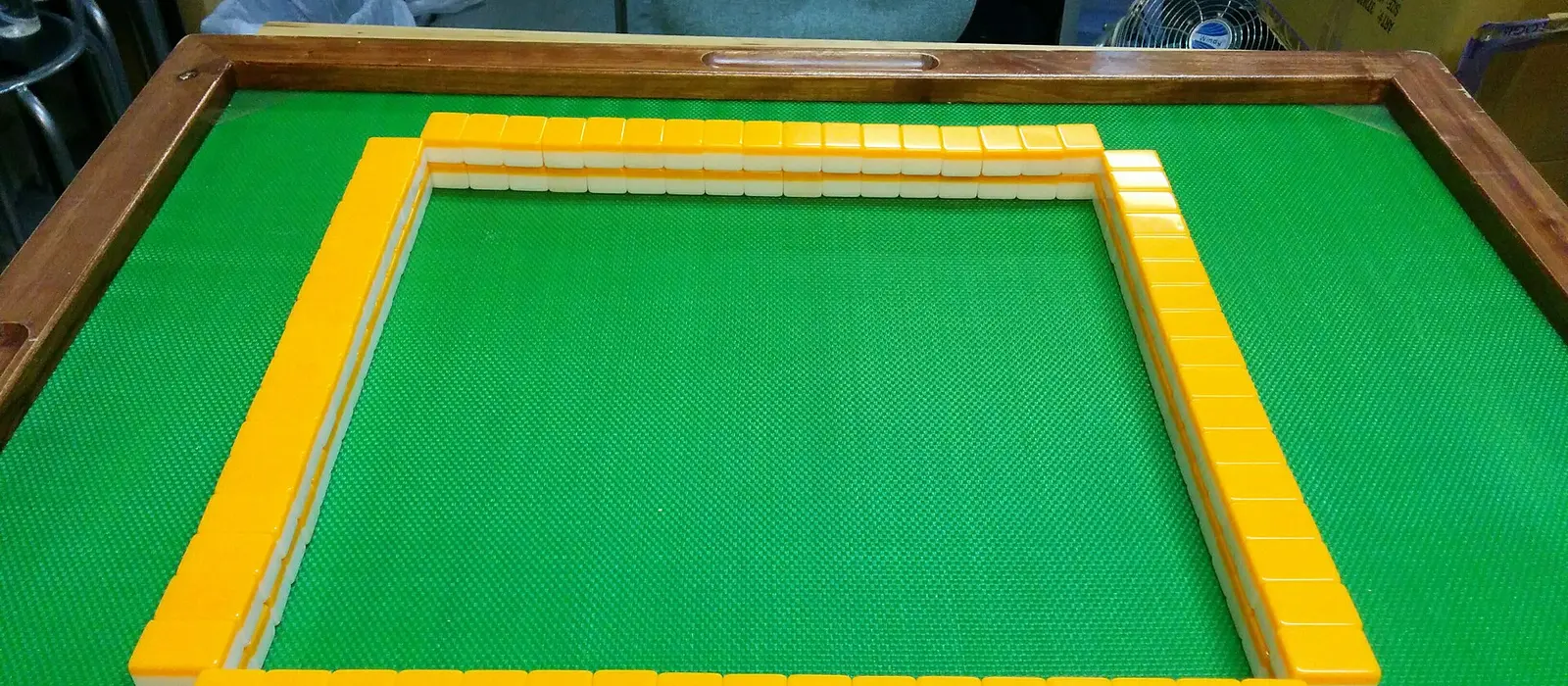
A blind pass lets you send on tiles you just received without looking at them. It is allowed only on the last pass of each Charleston in American mahjong.
Calling has two meanings. It can mean claiming a discard by naming a set, as in "pung" or "chi". It can also describe a hand that needs one tile to win, as in "calling 3 bamboo".
The Charleston is the set of tile passes American mahjong players make after the deal and before the first discard, three tiles at a time.
A chicken hand is a complete winning hand in Hong Kong mahjong that scores zero faan. Tables with a minimum faan rule usually do not let you win with one.
A chow is three tiles in a row from one suit, such as 3-4-5 of bamboo. Riichi, Hong Kong and Taiwanese play use chows; American mahjong does not allow them.
A concealed hand is one you build entirely from your own draws, without claiming discards for sets. Riichi calls it a closed hand, and some hands in every style must be concealed.
In American mahjong, the courtesy pass is the optional trade of up to three tiles between players sitting across from each other, made after the Charleston.
In American mahjong, a dead hand is one that can no longer win because of an error, such as a wrong tile count or an incorrect exposure.
The dead wall is a short section of the wall set aside at the break. Players do not draw from it in normal turns; it supplies replacement tiles after a kong or a flower.
The dealer is the player in the East seat for the current hand. The dealer starts play with one extra tile, and in Chinese and Japanese styles wins and losses by the dealer often count for more.
A discard is the tile you put face up on the table at the end of your turn so your hand returns to its normal size. Other players may claim the newest discard to complete a set or win.
A dora is a bonus tile that adds one han for each copy in your winning hand. The dora indicator in the dead wall shows which tile is dora.
The dragons are three honor tiles: red (中), green (發) and white (a blank or framed tile). In riichi and Hong Kong play, a pung of any dragon always scores.
An exposure is a group of tiles you place face up after claiming a discard. American players use the word for an exposed pung, kong, quint or sextet; other styles say exposed or melded set.
Faan is the unit Hong Kong mahjong uses to score a winning hand. You earn faan for patterns and for how you win, and the payment roughly doubles with each extra faan.
Flowers are extra tiles outside the suits and honors, usually four flowers and four seasons. Hong Kong and Taiwanese play set them aside for bonus points, while American play uses them in card hands.
Fu, or minipoints, is the second scoring unit in riichi. You count fu from your groups, your pair, your wait and how you won, then round up to the next 10.
Furiten is the rule that stops you winning by ron when you have discarded one of your own winning tiles, or have just passed on a winning discard.
Han is the main scoring unit in riichi mahjong. You earn han from yaku and dora, and each extra han roughly doubles the hand until you reach the limits.
Honba, called continuance counters in the WRC rules, are 100-point sticks the dealer puts out after a dealer win or a drawn hand. Each one adds 300 points to the next win.
Honor tiles are the winds (east, south, west, north) and the dragons (red, green, white). They have no number and no suit, so they can form pungs, kongs and pairs but never chows.
An American mahjong set has 8 joker tiles. A joker is a wild tile that can stand in for any tile in a group of three or more identical tiles.
A joker exchange is when you swap the real tile for a joker that sits in an exposed group on any player's rack. It can only be done on your own turn.
A kong is four identical tiles. Because it uses one more tile than a pung, the player who declares a kong draws an extra replacement tile so the hand stays the right size.
The National Mah Jongg League prints a new card each year listing every hand you may win with in American mahjong and how many points each one is worth.
The minimum faan is the smallest score a Hong Kong mahjong hand must reach before you can declare a win. Three faan is the most common choice, but each table sets its own.
A pair is two identical tiles. Most winning hands in Chinese and Japanese styles need four sets plus one pair, which Hong Kong players often call the eyes.
The prevailing wind is the wind of the current round, the same for every player. Hong Kong games play an East round, then South, West and North; riichi calls it the round wind and usually stops after South.
A pung is a set of three identical tiles, such as three 5 dots or three red dragons. Every major style uses it, though riichi players call it pon and a triplet.
A red five is a 5 tile printed in red that counts as a dora by itself. Many riichi groups use them, but WRC tournament rules do not.
Riichi is the declaration you make when your closed hand is one tile from complete. You pay 1,000 points and lock your hand in return for an extra han.
Ron is the call you make to win on a tile another player has just discarded. Only the player who discarded that tile pays for your hand.
Your seat wind is the wind of your position at the table for the current hand. The dealer is always East, the player on the dealer's right is South, across is West, and the left is North.
A self-draw win is when the tile that completes your hand comes from the wall on your own turn, not from a discard. It usually pays more, because every other player shares the cost.
Simples are the number tiles from 2 to 8 in each suit. Riichi calls them middle tiles, and a hand made only of simples scores the common yaku tanyao.
A sixteen-tile hand is the hand size used in Taiwanese mahjong. You hold 16 tiles and win with 17, made of five sets and a pair instead of the usual four sets and a pair.
The three suits are bamboo, dots and characters, each numbered 1 to 9 with four copies of every tile. Together they make 108 of the tiles in a standard set.
Tai is the scoring unit in Taiwanese mahjong. You add up the tai for each pattern in your winning hand, and payment grows in a straight line with each tai instead of doubling.
Tenpai means your hand needs just one more tile to be complete. It matters for declaring riichi and for the payments made when the wall runs out.
Terminals are the ones and nines of the three suits, six kinds of tile in all. They sit at the ends of each suit, so each one fits only a single run.
Tsumo means winning on a tile you draw yourself. All three opponents pay, and a closed hand won this way also earns the menzen tsumo yaku.
The wall is the square of face-down tiles, stacked two high, that players build at the start of each hand. You deal from it and draw from it in turn.
The winds are four honor tiles named for the compass points. They also name the four seats at the table, and in Chinese and Japanese styles a wind can score more when it matches your seat or the round.
A yaku is a scoring pattern from the official list. Your hand must have at least one yaku to win, even if it is otherwise complete.
A yakuman is a limit hand, the highest-scoring kind of win. Under WRC rules it pays 32,000 points to a non-dealer and 48,000 to the dealer.
Find a mahjong teacher, club, or open game near you.