
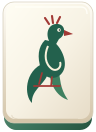
About this tile
Chinese and Hong Kong sets usually paint a sparrow on it, while Japanese sets most often show a peacock. The earliest sets had no bird at all, only one bent string of coins with a red knot. In riichi it is called ii sou, and the only run it can join is 1-2-3 of bamboo.
- Suit or group
- Bamboo
- English name
- One bamboo
- Chinese name
- 一條
- Japanese name
- Ii sou
- Copies in a American set
- 4
- Copies in a Riichi set
- 4
- Copies in a Hong Kong set
- 4
- Copies in a Taiwanese set
- 4
How each style uses it
- American
- American players call it 1 bam; it appears in card hands as a single, pair, pung, kong or larger group, but never in a called chow, since American rules have no chows.
- Riichi
- In riichi it is a terminal (routouhai) and can sit in the run 1-2-3.
- Hong Kong
- Hong Kong players use it in pungs, kongs, pairs and the chow 1-2-3.
- Taiwanese
- Taiwanese rules count it as a terminal, and sets of terminals generally pay more than sets of simples, and it fits the 16-tile hand in chows, pungs, kongs or the pair.
Tile designs vary from set to set. Our illustrations show the common look of each tile.
Practice recognizing tilesSources & last checked
- en.wikipedia.org · Checked 2026-11-23
- en.wikipedia.org · Checked 2026-11-23
- riichi.wiki · Checked 2026-11-23
- en.wikipedia.org · Checked 2026-11-23
- mahjongtime.com · Checked 2026-11-23
- zh.wikipedia.org · Checked 2026-11-23
- sloperama.com · Checked 2026-11-23
- sloperama.com · Checked 2026-11-23
- riichi.wiki · Checked 2026-11-23